
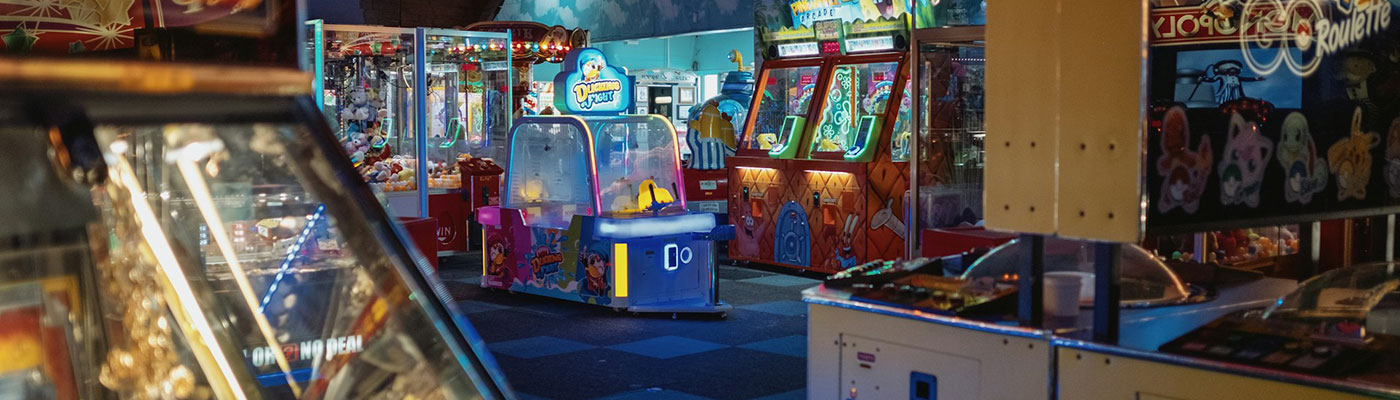
Pennies on the Pier
It usually started with a clutch of warm 2p coins pressed into your hand outside. Your parents wanted five minutes of peace. You had a better idea.
The penny falls were the gateway drug. You’d stand there for what felt like hours, timing your coin drops to the nanosecond, convinced that this one was going to bring down an avalanche of silver. It never quite did. The overhang always held. But the anticipation was everything: that frozen moment between dropping and landing where anything felt possible.
For millions of British children, the arcade was an early lesson in probability that no classroom ever taught.
The Fruit Machine Era
Walk deeper into the arcade and the atmosphere changed. The air was thicker, the lighting dimmer, the sounds more insistent. This was the domain of the fruit machine (or the puggy, if you were from Scotland).
Britain had a uniquely complicated relationship with these machines. Unlike the stripped-back slots of American casinos, British fruit machines were interactive. They had nudges, holds, skill stops and bonus trails. They rewarded attention and punished impatience. They made you feel like you were playing, even when the house had already won.
The designs were glorious. Cascades of cherries, lemons and bells. Names like “Nudge Bonanza”, “Super Hi-Lo” and “Big Dipper”. Cabinets in lurid orange and yellow that caught the eye from twenty paces. If you want a deeper dive into the complicated feelings they stirred, Retromash has an excellent piece on the love/hate relationship with fruit machines that will resonate with anyone who ever watched their pocket money vanish one 10p at a time.
Beyond the Fruit Machine: The Full Arcade Experience
The fruit machines were the headliner, but the supporting cast was just as rich.
Air hockey tables where the puck moved faster than your reflexes. Claw machines dangling cheap stuffed animals just out of reach. Racing simulators that tilted and juddered with a violence that would fail modern health and safety assessments. Video game cabinets, Pac-Man, Space Invaders, Street Fighter II, lined up in rows, each glowing with a promise of digital adventure.
And then there were the quiz machines. The ones with multiple choice questions about 1970s television presenters and the capital cities of obscure nations. Regulars developed a kind of sixth sense for the patterns. It was pub quiz culture before the pub quiz, democratised and coin-operated.
Why the Arcade Mattered
These places weren’t just about winning. They were social spaces: chaotic, democratic, buzzing with that specific energy of a crowd gathered around something uncertain.
According to the UK Gambling Commission, gaming and amusements have been woven into British leisure culture for generations, with the industry tracing its roots directly back to the Victorian fairground tradition. The modern regulatory framework recognises this heritage, drawing a careful distinction between low-stakes amusements and higher-stakes gambling.
That heritage shapes the way British players approach games today. The instinct for interactive play, the nudge, the hold, the moment of decision, is something that designers of new online casinos have taken seriously, building in bonus features and gamified mechanics that echo those old arcade instincts.
The Decline, the Legacy, and the Comeback
The seaside arcade didn’t disappear overnight. It faded, slowly and then quickly, as smartphones arrived and the under-18 entertainment market fractured into a thousand pieces. You can still find them on the piers at Brighton and Southend, in Blackpool and Scarborough, but they carry a wistful quality now. Heritage, as much as entertainment.
But something unexpected has happened over the last year or two. Retro gaming isn’t just surviving: it’s thriving. Dedicated retro gaming markets have appeared in cities across the UK, drawing families and collectors who’d rather spend a fiver on a classic cartridge than eighty pounds on a new release. The BBC reported in 2025 on a growing movement of players deliberately going retro, partly as a response to the rising cost of living, but also out of a genuine love for games that are simpler, more communal, and more playful than much of what the modern games industry produces. Andy Spencer, who runs the Retro Computer Museum in Leicester, put it plainly: if you’ve got a Sega Mega Drive, you can pick up Sonic the Hedgehog for a fiver and play it for days.
The revival goes beyond cost. It’s about what those old machines represented: a kind of uncomplicated fun, a shared experience, a game you could pick up without a tutorial or a subscription. That’s the same instinct that drew a generation to the seaside arcade in the first place. The coins and the cabinets may be long gone, but the feeling they created has never really left us.