
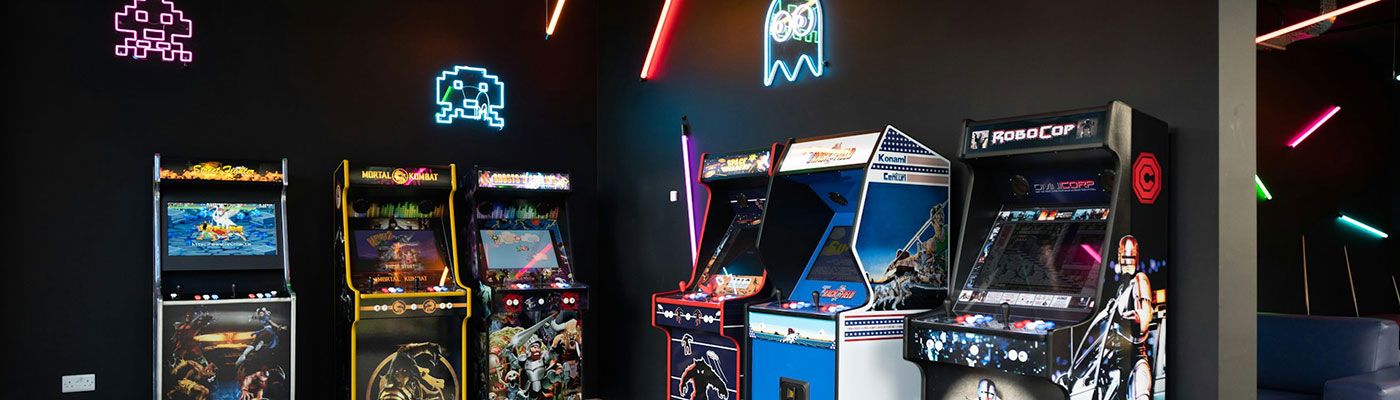
I’ve written before about the noise a good arcade made. Thirty attract loops shouting over each other at a room that mostly wasn’t listening, every one of them designed to be audible from the chip shop doorway. None of that was decoration. Everything in there was engineered to reward you constantly and loudly, because the machine only earned if you kept feeding it, and the way to keep somebody feeding it was to make the feeding feel good.
Visuals, audio and the high-score loop
The reel machines were in those rooms too, and had been for years before the video cabinets turned up. That same classic three-reel format is still running, on phones now, and these types of online slot games are the oldest thing in any modern casino catalogue by several decades. Hippodrome carries them under a name it borrowed from the Frank Matcham circus variety theatre on Cranbourn Street, which opened in January 1900 and turned casino in 2012. I am aware I am the one drawing that line. Nobody at either end of it was thinking about the other.
Tomohiro Nishikado built Space Invaders at Taito in 1978, handling, by Taito’s own account, every stage of the software including the character design. It was the first Japanese game to run on a microprocessor, and it put a high score at the top of the screen, which soon became a standard element of arcade games. A number that cost nothing to print and turned a solitary machine into a competition with strangers.
Toru Iwatani’s Pac-Man followed in July 1980, with Shigeo Funaki programming and Toshio Kai on sound, and Miyamoto’s Donkey Kong arrived in 1981. The aliens in Space Invaders speed up as you shoot them, and I always took that for inspired difficulty design. It probably wasn’t. The 8080 had to reposition and collision-check all 55 aliens on every pass, so the loop ran faster as their number fell, and a coder who went through the original ROM last October reckons there is no speed-adjusting instruction in it anywhere.
From joystick challenges to bonus rounds
The reel games inherited the sound design and the reward pacing wholesale. I went looking for academic work on arcade cabinets and found a pile of it on slot machines instead, which is much better funded, for reasons you can probably guess.
Dixon and Harrigan’s group at Waterloo gave the central trick a name in 2010: the loss disguised as a win, where a multi-line spin pays back less than you staked and plays the win animation anyway. Their follow-up is the one that stuck with me. Turning the sound off did not help much, and players still misread most of those spins as wins. Adding a distinctly negative sound did, taking correct identification from roughly four in ten to nearly seven in ten. Luke Clark’s near-miss work found the same lever pulled the other way, with a near-miss lighting up win-related brain circuitry while making people keener to carry on. Read those back to back and the family resemblance to a cabinet built to make a room look at it is not subtle.
Which is why I did a double take at the current rules. The Gambling Commission’s technical standards say a gambling system “must not celebrate a return which is less than or equal to the total stake gambled”. It has bound slots since October 2021, and from 17 January 2025 it covers casino games generally. The same standards require a minimum of 2.5 seconds between slot game cycles and ban turbo and quick-spin features outright. An arcade operator in 1984 would have recognised most of that list as the job.
The enduring appeal of retro aesthetics
The look, meanwhile, is untouchable. Synthwave, scanline filters, chunky pixel fonts and that purple-into-cyan gradient are everywhere, and will be for as long as the people commissioning artwork are the people who were eleven in 1986. I say that as somebody who has fallen for it repeatedly and will again. I still prefer the cabinets. An arcade machine had a coin slot in the front and a bezel telling you the credit price, and the whole transaction was visible from ten feet away. If you’d rather I stopped theorising, the finished cabinet is here, twenty-three parts later, coin door and all.